
Sunday, March 24, 2019
Reading Shakespeare aloud
Dear friends in Shakespeare: I have just stumbled over what looks like a fascinating and useful website. Check it out at Lee Jamieson's site. How to Read Shakespeare Dialogue Aloud.
https://www.thoughtco.com/dialogue-how-to-read-shakespeare-aloud-2985078

Thursday, March 21, 2019
Shakespeare’s French
The following
post by Rob Baxter comes from our recent newsletter
Shakespeare uses a surprising amount of French in his
plays, especially in Henry V. But
that use of the French language is not the only way in which French is part of
Shakespeare’s language. The vast majority of Shakespeare’s vocabulary comes
from French. More profoundly, much of the grammar and the syntax of
Shakespeare’s language comes from French. (The English Project ‘Henry and the
French Language n.d.’)
French began to be an influence on the English language
with the arrival of the French-speaking Norman kings in 1066. In the next five
hundred years, English was massively refashioned by French so that by the time
Shakespeare was born, English had become a fusion language. (Mulvey 2016)
Some scholars who have examined different aspects of the
plays have discovered borrowings from French sources, and apparent allusion to
French personages and events, and, of course, the plays include French phrases
and occasional exchanges in French. Let
us consider Shakespeare’s use of French in just three of his plays, Henry V, Love’s Labour’s Lost and Hamlet.
Henry V
Henry V is a play that rejoices in its hero king, Henry, warrior
and wooer. Henry V not only defeated the French; he went on to win the hand of
Katherine, the daughter of the King of France. Henry is powerful and kingly in
battle. He is playful and winning in courtship.
In Henry
V we find more than a dozen French lines for the soldiers including the
exchange:
Boy. Encore
qu'il est contre son jurement de pardonner
aucun prisonnier, neanmoins, pour les ecus que vous
l'avez promis, il est content de vous donner la
liberte, le franchisement.
aucun prisonnier, neanmoins, pour les ecus que vous
l'avez promis, il est content de vous donner la
liberte, le franchisement.
[“Although it is against
his oath to pardon any prisoner, nevertheless, for the sake of the crowns you
have promised, he is willing to give you your liberty, your freedom”]
French Soldier. Sur mes genoux je vous donne mille
remercimens; et je m'estime heureux que je suis tombe entre les
mains d'un chevalier, je pense, le plus brave,
vaillant, et tres distingue seigneur d'Angleterre.
mains d'un chevalier, je pense, le plus brave,
vaillant, et tres distingue seigneur d'Angleterre.
[“On my knees, I give you
a thousand thanks, and I consider myself happy that I have fallen into hands of
a knight, as I think, the bravest, most valiant, and very distinguished
gentleman in England”] [4.4.52-62]
This shows some, but not conclusive evidence, that
Shakespeare could write fluent French. In the next Act there is the rather
naughty scene between Katherine and her maid, Alice, where the latter teaches
the former some English translation of French words. Whilst Shakespeare shows that he is familiar
with French it can be seen that he is also boasting about the superiority of
English. (The English Project ‘Henry and the French Language n.d.’)
The subject is parts of the body, so Katherine learns
single words ‘de sin’, ‘de fingres’, ‘de mailes’ and ‘de bilbow’
which with a hint of a French accent is probably not so different from a French
vocabulary lesson even today.
The play demonstrates Shakespeare’s knowledge of conversational
French, with its sideways glance at the verb ‘baiser’, which, for unsuspecting English audiences means 'to kiss',
leaving its more sexual connotations for those French-speaking members of the
audience alone. Shakespeare playfully uses the ‘double entendre’ word as a verb
four times and is well aware that it was a word one had to be careful with.
(White 2015)
The untranslated ‘baiser’
presents a space into which the English translation cannot reach. For French-speaking
members of the audience, it denotes an extremely vulgar expression ‘to f**k’; French folk would assume use of the
dirty expression, unless it's in a very well-known phrase like "baiser la main" [‘to kiss the
hand’], a phrase Shakespeare actually uses in the dialogue. (Montgomery 2012)
History tells us that it was just at the time that Henry
was courting Kate – 1415 - that the English language was triumphing in England;
it was finally overcoming French as the language of authority and power.
Henry’s father had deposed Richard II by an order read in English and the
Henrys made English the language of their court. (The English Project)
There is more French spoken in Henry V than in any other Shakespeare play, more in fact, than in
any other English play of that period. From 1066 onwards, England had been
ruled in French and educated in Latin. English had been a despised tongue
though it never ceased to be a written language, as in William Langland's Piers Plowman and Geoffrey Chaucer’s Canterbury Tales.
Henry V is not only a play about the defeat of the French army;
it is also a play about the defeat of the French language. The English king is
triumphant. So is Shakespeare’s English!
Hamlet
Turning to Hamlet,
the Memoire’s of Queen Marguerite de
Valois, contain the tragic story of a young girl at court who dies for love and
grief.
A young lord, living in the same household, falls in love
with this young woman. Their love is
thwarted by the family objections; the young girl has a domineering
parent. Her lover then turns cruel and
rejects her.
She tries to hide her distress, but then breaks down, and
dies within days, mourned by a queen. Her lover returns, and comes across a
funeral procession. The coffin is strewn
with flowers. He wonders whose funeral it is, and then realises it is his
beloved’s. (Wikipedia: Margaret of
Valois)
Does the
story ring a bell with you? It sounds
familiar, though the participants are not Ophelia and Hamlet, but Hélène de
Tournon and the Marquis de Varenbon. Had Shakespeare read some of Marguerite’s Memoires as she had been born in 1553
and the letters seem to have been written in the latter part of the 16th
century?
Love’s
Labour’s Lost
And fascinatingly, Shakespeare found her a muse as well,
basing the events of his comedy Love’s
Labour’s Lost on Marguerite’s relationship with Navarre whom she married
unwillingly in 1572.
Marguerite describes how in 1578, separated from her
husband, she accompanied her mother, Catherine de Médici, as ambassadress of
France in negotiations with Henry of Navarre. On this occasion she attempted to
influence the outcome of the negotiations by employing the charms of the
ladies-in-waiting on Henry and his lords. Like the princess in the play,
Marguerite was witty and charming.
The Mémoires
contain many particulars of her life, together with anecdotes told with a saucy
vivacity which is charming, and an air vividly recalling the sprightly
demeanour and black, sparkling eyes of the fair Queen of Navarre. Marguerite
died in 1615, aged sixty-three. These letters contain the secret history of the
Court of France during the seventeen eventful years 1565-82.
 |
| Marguerite de Valois |
Hélène de Tournon, daughter of one of Marguerite de Valois' ladies-in-waiting, died for the love of a young nobleman, the Marquis de Varenbon, an incident that is the source for the story of Katharine’s sister in Love’s Labour’s Lost. (Boyce, 2005)The tragic death of Hélène de Tournon was probably the
source for that of Ophelia in Hamlet
who dies broken-hearted, rejected by Hamlet (as mentioned earlier), the man she
loves who has also killed her father. The Marquis learned of the death of
Hélène de Tournon when, on returning to Liège (from where he had been absent at
the time Hélène died), he encountered the funeral procession, just as Hamlet
encounters the funeral procession of Ophelia on his return to Elsinore.
Shakespeare knew of this tragic incident, which was not
publicly known until Marguerite de Valois’ Mémoires
were published in 1628.
Shakespeare’s Library
The question arises as to how Shakespeare acquired his
knowledge of the French language. Concerning Shakespeare’s proficiency Kenneth
Muir (1977) writes:
‘Of modern languages Shakespeare acquired some knowledge
in French… He could certainly read
French…’
Stuart Gillespie (2001)
makes reference to John Eliot’s book written for “English Gentlemen”, published
in London in 1593 under the extended title
“Ortho-epia Gallica: Eliot’s fruits for
the French, Enterlaced with a double new Inuention, which teacheth to speake truely, speedily and
volubly the French-tongue.
Penned for the practise, pleasure, and
profit of all English Gentlemen, who will endevour by their owne paine, studie,
and dilligence, to attaine the naturall Accent, the true Pronounciation, the
swift and glib Grace of this Noble, Famous, and Courtly Language”
and describes the French
language manual as one Shakespeare might have had in his possession and seems
“exactly the type of
book Shakespeare could have used to teach himself French”.
Robert Miola (2000) goes further referring to the French
‘teach yourself’ books Shakespeare might have acquired to further his studies:
‘Shakespeare’s library certainly contained books in
French…including a French conversation manual, and perhaps works by Boaistuau
and Belleforest.’
Belleforest’s Les Histoires Tragiques is a 1514 translation
of the story of the 12th century Latin Amlethus into French (Amleth) and one of the sources
Shakespeare used for Hamlet. The play
makes more than fifty allusions to characters, events or words and phrases in
Belleforest’s Les Histoires Tragiques, published
(in French) in 1572.
These scholars—Muir,
Gillespie and Miola—and Shakespeare himself show that he was sufficiently fluent
in French to read and make use of French sources and was also familiar with a
French person’s vernacular.
Miola’s reference to
Shakespeare’s library has exercised the minds of many. Shakespeare’s will runs to three pages, over a
thousand words, with no mention of any book, whether a bible, texts of any
poems or plays, or any sources. The
absence of books is a marked feature of the will. No inventory of books to which a lawyer
would, as a matter of practice, make specific reference in the will (for it be
valid in law), is known to exist.
One of the few
biographical details we know for certain about Shakespeare is how much he read.
Over 200 books are quoted in his plays or serve as sources for them.
What did he read? Mostly
history, literature, plays, and poems, with some books on mathematics and
medicine. It would certainly seem to follow that Shakespeare either owned such
books or had access to these relatively scarce books.
Where did he read books?
There were no public libraries in England. The largest known library was Lord
Lumley’s (1533-1609); he was an English aristocrat whose library contained some
7000 volumes; this collection became the original British Library. There were
about 10 libraries of over 1000 volumes in England: the Queen’s, the
universities’, the Inns of Court’s, and several other private libraries,
including Sir William Cecil's.
Shakespeare was not a
student at a university or an Inn of Court, nor is he known to have been
patronized by any of the owners of large libraries. He must have been
self-taught.
Stuart Kells (2018) has
researched this enigma and writes
‘Over the span of four
hundred years, people sought [Shakespeare’s] library out….In all this time, the
search came to nought [sic]. Not a trace of his library was found. No books, no
manuscripts, no letters, no diaries….’
Kells suggests that one
reason the library has been lost is because Shakespeare wasn't really a
literary figure in his own time.
‘The idea of a literary
Shakespeare as this inspired author was really created in the 18th and 19th
centuries….In his time, he was a workaday dramatist, he had [many] other things
on the go, [including] investing in theatres."
It seems that there is
no satisfactory explanation of this puzzle; searches for any library, indeed
any books of any description, belonging to Shakespeare, have led nowhere.
References
Boyce, C (2005) ‘KATHARINE’ in William
Shakespeare: A Literary Reference to his Life and Work, Vol 1 Facts on File,
New York
Gillespie S (2001) SHAKESPEARE’S BOOKS:
The Athlone Press
Kells, S (2000) SHAKESPEARE’S LIBRARY
Text Publishing, Melbourne
Miola R (2000) SHAKESPEARE’S READING
Oxford, OUP
Montgomery M (2012) EUROPE’S LANGUAGES
ON ENGLAND’S STAGES 1590-1620: Ashgate, London
Muir K (1977) THE SOURCES OF
SHAKESPEARE’S PLAYS Methuen & Co. Ltd., London
Mulvey C (2016) ‘WILLIAM SHAKESPEARE: A
FRENCH POET?’ A Parisian Celebration of the 400th Anniversary of His Death: 25
May 2016, http://www.englishproject.org/william-shakespeare-french-poet
The English Project ‘HENRY AND THE FRENCH
LANGUAGE’ http://www.englishproject.org/march-henry-v-and-french-language (accessed 15 Jan 2019)
White R et al. (eds.) (2015)
SHAKESPEARE AND EMOTIONS, INHERITANCES, ENACTMENTS, LEGACIES Palgrave
Macmillan, London
Wikipedia contributors, "MARGARET
OF VALOIS," Wikipedia, The Free Encyclopedia
https://en.wikipedia.org/w/index.php?title=Margaret_of_Valois&oldid=866275829
(accessed January 15, 2019
Tuesday, December 4, 2018
Queens in Shakespeare's plays
What a fascinating topic! Our president, Frances, has researched and commented on Shakespeare's depiction of the Queen consorts depicted in his histories.
A comment by fellow member Claudia a few months ago has set me thinking
about the history plays. We had just
finished reading Henry IV part 2 and
she mentioned an interesting little detail: there was no queen in the play.
Beginning way back with King
John, all the other English histories feature at least one queen, sometimes
several, and while most are relatively minor, some are quite significant and
certainly very interesting characters.
There is no wife in King
John, but his mother Queen Elinor is an outspoken woman. In the very first scene she feels free to
comment disapprovingly on the French ambassador.
She is a strong supporter of her son, to the extent that she
is not too scrupulous about legal questions:
“Your strong possession much more than your right,
Or else it must go wrong with you and me:
So much my conscience whispers in your ear,
Which none but heaven and you and I shall hear.”
Elinor is so well ensconced in the court that she follows
John to France, giving her opinion and advice frankly, often acting as though a
reigning queen herself. She is decisive
and confident in her own judgement, making a surprisingly quick decision to
adopt the Bastard, Falconbridge, as her grandson.
So firm is her backing of her son that she openly reveals
her antipathy to Constance’s demands for Arthur’s rights, and accuses Constance
of promoting Arthur’s claims so that she can be queen. She uses phrases such as “that ambitious
Constance”, “Thou monstrous slanderer”, “Thou unadvised scold” and calls her
“insolent”. We notice that she makes no
effort to dissuade John from his plan to have Arthur murdered.
After making a strong impression in the first half of the
play, she disappears from the action of the battles and John’s final downfall.
John’s great great grandson was Edward III. In the play Edward III we meet good Queen Philippa. Her virtue and beauty have so strong an
influence that, when Edward sees her features mirrored in their son’s face, he
is instantly released from his overpowering infatuation with the Countess of
Warwick.
Philippa accompanies him to the battlefields of France, and
it is her pleading which saves the brave burghers of Calais from Edward’s
vengeance.
In real life she did indeed follow him on all his travels in
England and France, and bore him many children, including Edward the Black
Prince, father of Richard II, and several other sons who became the influential
uncles in Richard’s life.
Richard II was Edward’s grandson. In Richard
II the queen is not even named. She takes no part in state affairs, having
only a domestic role.
She is devoted to her husband, calling him “my sweet
Richard” and is much distressed when they are parted by his going to
Ireland. Her nervous sense of impending
doom is justified by news of Bolingbroke’s arrival back in England, saying
“I….have woe to woe, sorrow to sorrow joined.”
This is more strongly expressed when she eavesdrops on the gardeners:
“They’ll talk of state, for every one doth so Against a change; woe is forerun
with woe.”
She rallies slightly and shows some spirit in scolding the
gardeners’ talk of the king’s likely deposition: “….for telling me these news
of woe, Pray God the plants thou graft’st may never grow.”
The last we see of her is as she waits for Richard to pass
in the street on the way to the Tower.
They take a very tender and loving farewell of each other.
The usurper, Bolingbroke, was crowned Henry IV, and as was
noted, the Henry IV plays do not
feature a queen. In fact, the real Henry
IV was married twice and managed to sire six children with his first wife, in
between all the insurrections and battles.
Henry V also does
not have an actual queen, but we meet Princess Katharine of France, who would
become Henry’s wife after the events of the play. Our first glimpse of her shows her learning
English with her lady-in-waiting, revealing self-confidence and a youthful
sense of fun.
Later, when Henry has reached agreement with the King of
France, she faces a fairly business-like courtship. Henry has told the King that she (Katharine)
“is our capital demand, comprised Within the fore-rank of our articles” –
referring to the schedule of English stipulations for peace.
Henry tells her: “Take me, take a soldier.” She resists for some time: “Is it possible that I sould love de enemy of
France?” “I cannot tell.’ “I do not know.” “As it sall please de roi, mon pere.”
However, on being assured that her father approves, she
softens and eventually yields to his kisses.
It is interesting to note that from there she says not another word!
Henry V died young, and his infant son became Henry VI at a
tender age. The three plays comprising Henry VI feature probably the most unforgettable queen
of them all: Margaret of Anjou.
When her marriage to Henry is arranged she stuns the envoy
Suffolk, and then her new husband, with her beauty, but soon reveals her steely
ambition and a callous determination to be more than a decorative consort. She quickly sums up the power structures of
the court and deviously plots her way to control. She takes little trouble to disguise her
affair with Suffolk, or to hide her impatient scorn for her gentle husband.
Margaret is devastated when Suffolk is murdered, but her
response shows her firm resolve as she tells herself:
“Oft have I heard that grief softens the mind,
And makes it fearful and degenerate;
Think therefore on revenge and cease to weep.”
She becomes a warrior queen, recognising Henry’s lack of
martial spirit, and devises strategy and directs action.
Margaret is furious with Henry over his agreement with York
about the succession, and shows her devotion to her son:
“Art thou King, and will be forced? I shame to hear thee speak. Ah, timorous
wretch! Thou hast undone thyself, thy son, and me.”
Her treatment of the captive York shows her at her worst,
delighting in the death of York’s son.
York’s invective sums up her chilling cruelty:
“O tiger’s heart wrapped in a woman’s hide! How couldst thou drain the life-blood of the
child To bid the father wipe his tears
withal, And yet be seen to bear a woman’s face?”
As the wars drag on, Margaret becomes the courageous leader,
even displaying diplomatic skill when pleading for help from the King of
France. Her valiant spirit shines before
the battle of Tewkesbury; she inspires her followers with patriotic zeal,
ending her speech: “Henry, your
sovereign, is prisoner to the foe; his state usurp’d……And yonder is the wolf
that makes this spoil. You fight in
justice; then, in God’s name, lords, Be valiant, and give signal to the fight.”
Alas, she and her son are captured; she is forced to watch
the prince’s murder, lamenting with heartbreaking sincerity. She exits, cursing the York brothers: “So come to you and yours, as to this
prince!”
Although at the end of Henry
VI part 3, King Edward orders that Margaret be returned to France, she
reappears in Richard III, still
resentful and insisting on her right to be England’s queen. She seems the personification of hatred,
completely obsessed with the reversals of her fortunes, and shows startling
imagination in the range of insults and curses she flings at Richard. Even in Henry
VI she called Richard: “…a foul
mis-shapen stigmatic, Mark’d by the destinies to be avoided, As venom toads, or
lizard’s dreadful stings.” And so in the
later play she adds: bottled spider;
hell-hound; cacodemon; elvish-marked, abortive, rooting hog. Among her curses: “The worm of conscience
still begnaw thy soul! Thy friends
suspect for traitors while thou livest, And take deep traitors for thy dearest
friends.”
As Hastings comments: “My hair doth stand on end to hear her
curses.”
She “lurks” (to use her own word) about the court, to
observe the workings of fate on her enemies and she finds grim satisfaction in
Queen Elizabeth’s grief for her young sons:
“Plantagenet doth quit Plantagenet,
Edward for Edward pays a dying debt.”
After metaphorically placing all her woes on Queen
Elizabeth, she finally resolves to leave all behind and return to France:
“Now thy proud neck bears half my burthen’d yoke;
From which even here I slip my weary neck,
And leave the burthen of it all on thee.
Farewell, York’s wife, and queen of sad mischance:
These English woes will make me smile in France.”
Margaret is such a powerful character that one can almost
overlook poor Queen Elizabeth, widow of Edward IV, and a third queen,
Anne. Anne was the widow of Henry VI’s
son and inexplicably agrees to marry Richard.
She soon has reason to feel regret and shame.
The last play is Henry
VIII, where we meet Queen Katharine of Aragon, a noble and dignified woman,
concerned for justice both in government and in her own claims. She pleads her case against divorce strongly,
but continues to be loyal to Henry and accepts her fate with resignation.
 |
| Anne Boleyn, artist unknown (courtesy Wikipedia) |
Katharine is supplanted by Anne Bullen, a lady who enjoys a
party, and whose beauty soon catches the king’s attention. She expresses sympathy with Katharine’s
plight, but clearly does not convince her interlocutor, and shows secret
pleasure in her predecessor’s downfall.
We do not see her coronation, but her appearance and
behaviour are described by onlookers most admiringly.
This is hardly
surprising, given that she was the mother of the real-life Elizabeth I, ruler
of England for the greater part of Shakespeare’s life. Writers had to be careful, even if the play
was written after Elizabeth’s death.
I have enjoyed this little excursion through the history
plays. It has given me a different way
of looking at the works, and the chance to think about characters who might not
otherwise attract so much of my attention.
Wednesday, September 5, 2018
What's next?

The October and November meetings will be devoted to reading and discussing Titus Andronicus, then December brings a Christmas concert. (Once the contents have been decided I shall put them up on the blog and the Facebook page.)
We usually have a social meeting sometime over the semester break, and that’s another fun thing to look forward to!
Wednesday, August 22, 2018
Julius Caesar 2018
Julius Caesar: the recent production by Bell Shakespeare
Company reviewed by Frances Dharmalingham.
A small group of Shakespeare
Club members attended a performance of Julius
Caesar at the Heath Ledger Theatre.
The first part of the play,
with its glimpses of Caesar’s disturbing ambition and the plotters’ reasons to
assassinate him, is challenging because it necessarily involves much talking: a
consideration of political ideas, mingled with very personal feelings,
particularly in the long dialogue between Cassius and Brutus. Cassius, played
by Nick Simpson-Deeks, spoke with admirable clarity as he presented his
arguments, but his slow delivery reduced the urgency of the situation. The
actor was perhaps aware of possible school audiences: they would certainly have
been able to note all the important steps in Cassius’s argument. For most of
the scene, he and Brutus were standing too far apart, on opposite sides of the
wide stage, which limited the required intensity and intimacy of the
conspiracy. Brutus (Ivan Donato) established immediately his sleep-deprived
confusion and desperate worry, but engaged in irritatingly repetitive, and therefore
distracting, gestures. His speech was frequently muffled.

Caesar was played by Kenneth
Ransom. His gestures were suitably imperious, and his commanding height was an
advantage: his voice, however, lacked the depth and resonance which would have
imbued his speech with a more convincing authority.
The central part of the play,
showing the events of the Ides of March, was engrossing and powerful. The
actual murder of Caesar was skilfully choreographed, almost in slow motion, as
one by one the senators took their turns to stab him and he finally faced
Brutus for the death blow. The actors sustained the tension well as their
characters came to terms with what they had done. I had some difficulty,
however, with the use of a bucket for ‘let us bathe our hands in Caesar’s blood’
and later, when Mark Antony presented the bucket to the crowd as Caesar’s
remains.
The exchanges between Brutus,
Cassius and Antony effectively revealed the differences in their characters,
which became even clearer in the great speeches to the people. It was a
surprise that the interval fell between Brutus’s and Antony’s speeches; we were
all waiting in keen anticipation for Antony’s riposte, and suddenly we had to
wait a lot longer! I wondered at the time whether this was a good idea, but it
certainly was. Mark Antony burst back on the scene after the interval, and gave
an absolutely masterly display of subtle oratory. Brutus had adopted a somewhat
defensive defiance when he addressed the crowd; it was fortunate that Antony
did not immediately follow him, as it would have seemed that he had little to
do to win the people’s favour over to his side.
Throughout the play Mark
Antony was outstanding. Sara Zwangobani’s emotional range, vocal control, and
clarity of diction allowed her to reveal every aspect of Antony’s character. As
well as the great speech to the people, Antony’s lamentation over Caesar’s corpse
was deeply affecting, and built to a finale of powerful ferocity. The actor
displayed fine judgement in handling the modulations of mood following this,
with the character immediately turning to war business, planning to contact
Octavius.
The third section of the
play, the aftermath of all that happens on the Ides of March, can sometimes
seem confused and a little disappointing after such dramatic action. Our little
group from the club all agreed that the entire second half of the performance
was much more engrossing than the first.
I had only one quibble. I
have always felt that the most dreadful death in the whole play is that of
Cinna the poet, murdered for no reason but that he shares the same name as a
conspirator. This follows immediately after Antony’s stirring up of the
plebeians, and serves to illustrate both his prophecy that Caesar’s spirit will
“cry Havoc” and his warning to Octavius that “here is a mourning Rome, a dangerous
Rome, no Rome of safety…” and the scene illustrates all the horror accompanying
the loss of civil order and the breakdown of the rule of law.
Several valuable minutes were
taken up in creating a set for homeless street-dwellers, with numbers of
mattresses (brand-new and difficult to manage!) and other accessories, before
the action could begin. This broke the momentum built in the preceding scene,
and detracted from the shock of the murder, for me. The set really was
unnecessary, since it was immediately (and again, obtrusively) dismantled,
causing needless distraction and delay again.
From that point on, however,
things moved fast and we had a very fine quarrel scene between Cassius and Brutus.
Here there was the necessary fire and energy accompanied by clear communication
of the ideas and feelings of the characters. Brutus handled the sudden change
of mood with most convincing laughter, and the transition to the sad news of
Portia’s death was genuinely touching.
The appearance of Caesar’s
ghost was suitably ethereal, but the device (? a microphone?) used to make his
speech more supernatural unfortunately made it difficult to understand his
words. This became a greater problem when the ghost returned in the last scene,
and replaced the several characters who are usually asked by Brutus to hold his
sword, for his suicide. This might have been justified by reference to Brutus’s
earlier exclamation after Cassius’s death: ‘O Julius Caesar, thou art mighty
yet, Thy spirit walks abroad and turns our swords In our own proper entrails.’ However
I was doubtful about the wisdom of taking the words so literally as to have
Caesar actually physically stabbing Brutus.
It was noteworthy that,
bearing in mind the requirements of gender equality, the cast consisted of even
numbers of men and women. This required all but one woman to play some male
roles. Interestingly, the characters all retained their male names as given by
Shakespeare, but (since they were dressed as women, and clearly being played by,
and as, women) they were referred to with feminine pronouns. This took some
getting used to! I sympathise with any female actor’s wish to play any part in
the play, and we have to admit that most of the best Shakespearean roles are
for men, but I believe that the performers should attempt to act the parts as
written: i.e. to present the characters as men, seriously, just as the young
male actors of the sixteenth century would have approached their roles as
women. I am sure there must be many different points of view on this subject.
The play’s setting was
non-specific: the strange but adaptable construction which served as the set
effectively suggested the back veranda of Brutus’s house, the steps of the
Forum, the mountains of the battlefield, and so on. The costumes were mainly
jeans and trainers, making it at times difficult to distinguish between
characters. There was some attempt to separate the patricians from the
plebeians, with Calpurnia, Octavius and Antony wearing more “fashionable”
clothes than most of the others. As to the period in which these events might
have been happening: I thought perhaps it was a few decades in the future. The
sound design was interesting, using discordant music at times to heighten the
drama, though sometimes at the risk of drowning the speech. Instead of vocal
shouts of the crowd during the long speeches, these unidentifiable noises
filled the pauses and created a clever impression of the sometimes inhuman
nature of a large and unpredictable horde. The lighting was well used to focus
on the action at any given point, leaving large areas of the stage only dimly
visible; this helped the small cast to create the illusion of much greater
numbers of characters, just out of sight.
Although the performance was
uneven, both in terms of the actors’ skills, and the extent of the audience’s
engagement in various scenes, I was left with much to think about. It certainly
made me return to the script of this great play, and appreciate it all over
again.
Friday, July 13, 2018
A Shakespeare Resource from Cambridge Press!
Shakespeare Club
member Peter Medd has created a post about a publication possibly unknown to
most of us. Here is what Peter has to say --
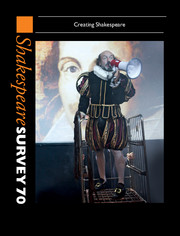 These volumes also contain some photographs of stage plays including
David Suchet as Shylock and Archilles (Troilus and Cressida) and Donald Sinden
as Lear, and Patrick Stewart as Titus.
Amongst my late father’s collection of Shakespearian related publications
are two volumes of ‘Shakespeare Survey’ numbers 33 and 35.
These were annual publications, published by Cambridge University Press,
which I believe started in the late 1940’s and are probably still being
published each year and contain studies and essays on Shakespeare works
by eminent scholars.
Numbers 33 and 35 were published in 1980 and 1982 respectively. Although
all the contents of these is fascinating, Volume 35 has an article ‘Shakespeare
on the Melbourne Stage 1843-1961’.
This contribution covers many pages, but it starts with the following
account which I found fascinating.
Barely ten years after John Batman, one of the first settlers in
Victoria, had made a treaty with the aborigines which the central government a
few years later decided to ignore, Othello
was played in Melbourne.
It was the first Shakespearean play to be staged in the colony, on 4
September 1843, under the management of Conrad Knowles, in a wooden shed in
Bourke Street which seated 500 and was called the Pavillion.
The article continues:
It was astonishing that Shakespeare was produced at all, for instead of
the ‘fashionable’ house that The Port
Phillip Gazette anticipated, Knowles had to contend with wild unruly
audiences.
This was the Yahoo period of Australian stage history when barbarism
reigned triumphant. When he played Shylock in September ‘certain parties’ were
refused admission to the dress circle.
These volumes also contain some photographs of stage plays including
David Suchet as Shylock and Archilles (Troilus and Cressida) and Donald Sinden
as Lear, and Patrick Stewart as Titus.
Footnote: I (Satima, your
trusty blog mistress) chased up this publication’s history. Apparently it
started in 1948, and the 2017 edition is now available. You can see for yourselves at https://www.cambridge.org/core/what-we-publish/collections/shakespeare-survey
Doesn’t this sound fascinating? I hope Peter will bring the magazines along to
a club meeting for a ‘show and tell’!
Saturday, May 26, 2018
King John
Frances, our president, has written a piece on this little-known play. Read on and be enlightened!
King John
I last looked at King
John in 2004 when we had a group reading of the play during regular Club
meetings. I was lucky enough to be given
the part of Constance, and I well remember her powerful support of her son’s
claim to the throne, her denunciations of the faithless French and Austrian
rulers, and most of all her heart-breaking demented grief over the loss of her
son. Her lament: Grief fills the room
up of my absent child… epitomises all bereaved mothers.
The rest of the play, however, had become something of a
blur and I enjoyed reading it again recently and re-discovering particularly
the character of Philip Faulconbridge, the Bastard. What a lively and convincingly human
portrayal!
Cheery and unabashed, he acknowledges his half-brother
Robert’s claim to the family inheritance, with an amusing acceptance that he is
a bastard drawing attention to the extreme differences between himself and his
father and brother:
Compare our faces and be judge yourself,
If old Sir Robert did beget us both.
Philip is tall, fair and sturdy, while he describes the
Roberts, elder and younger, as small, dark and sharp-featured:
O old Sir Robert, father, on my knee
I give heaven thanks I was not like to thee!
Queen Elinor perceives his likeness to her late son Richard
Lionheart, and greets him as her grandson, while King John accepts him as
nephew. They pose the question:
Whether hadst thou rather be a Faulconbridge….
……Or the reputed son of Coeur-de-Lion.
(by implication, with a name, but no property.)
King John dubs him knight and re-names him Richard
Plantagenet, at which the Bastard shows his adventurous and generous spirit,
turning to his half-brother:
Brother by the mother’s side, give me your hand:
My father gave me honour, yours gave land.
Now blessed be the hour, by night or day,
When I was got, Sir Robert was away!
He accepts what fate gives, with a sure sense of self and
neither shame nor blame for his mother’s marital misdemeanour. In fact he has a delightfully warm and frank
relationship with her:
With all my heart I thank thee for my father!
Who lives and dares but say thou didst not well
When I was got, I’ll send his soul to hell.
His irreverent sense of humour allows him to stand back at
times to observe and comment on the action, most notably in his anger at “Commodity”,
or what we might call self-interest for personal gain; but when his scorn is
spent, his basic honesty forces him to admit that he too is guilty of similar
faults:
And why rail I on this Commodity?
……
Since kings break faith upon commodity
Gain be my lord, for I will worship thee.
In attendance on King John in France he shows a natural
understanding of the strategies of war combined with skilful political
manipulation as he manoeuvres France and Austria against each other to
England’s advantage; he is just as ready to assume a tax-collector’s role back
at home when he duns the rich churchmen in their Abbeys, for gold to finance
John’s wars:
Bell, book and candle shall not drive me back
When gold and silver becks me to come on.
While he can be kind and loving in his treatment of family
or those in need, the Bastard doesn’t hesitate to show dislike or contempt, as
in his colourful insults to the Emperor of Austria. Later though, he learns to suspend judgement
and to avoid hasty conclusions, when he questions Hubert over Prince Arthur’s
death.
The Bastard’s character develops during the course of the
play; his young, perky self-confidence matures to serious patriotism as he
speaks for England in the face of treachery and threats of civil war. He berates the traitorous English barons who
ally themselves with France:
And you degenerate, you ingrate revolts,
You bloody Neroes, ripping up the womb
Of your dear mother, England, blush for shame.
and is constantly loyal and encouraging to King John,
sounding almost a fore-runner of Hotspur:
Be great in act, as you have been in thought.
Let not the world see fear and sad distrust
Govern the motion of a kingly eye.
Indeed he seems to bear the full weight of the hard-fought
battles alone; even the rebel Salisbury says of him:
That misbegotten devil, Faulconbridge,
In spite of spite, alone upholds the day.
After King John has died, the Bastard remains constant in
his loyalty to the new king, Henry:
…..with all submission, on my knee
I do bequeath my faithful services
And true subjection everlastingly.
and to his country.
He is allowed the final lines of the play as he expounds in ringing
tones the power of strong alliance between the barons; if they all stay loyal
to the English crown, the country can resist all outside threats:
Nought shall make us rue,
If England to itself do rest but true.
Subscribe to:
Posts (Atom)